
How to Search Criminal Dockets
Begin with the state's own tool, the Washington AOC Case Search. Pick the court level first, then the exact filing court. A felony belongs to Yakima County Superior Court. Misdemeanors, gross misdemeanors, criminal traffic matters, and probable-cause filings go through the limited-jurisdiction list instead. So match the court named on the notice. That list covers Yakima District Court with its Grandview entry. It also includes Yakima, Selah, Sunnyside, Toppenish, Granger, Wapato, Zillah, Moxee, and Union Gap court labels. A case number beats a name search every time. Names pull in strangers who share yours. Compare court, filing year, case type, and case number before you rely on any result. Then verify the match with the court of record.
- Select District and Municipal, Superior, or Appellate Courts.
- Choose the exact Yakima County filing court.
- Search by case number, exact party name, or business name where supported.
- Review event dates, court assignment, and disposition with care.
- Ask the proper clerk for the docket, judgment, plea form, or certified copy.
Yakima County Criminal Search Layers
Yakima County criminal dockets sit behind three layers, and each layer does a different job. AOC is the broad locator. The Odyssey Portal adds Smart Search, hearing search, and judgment search for participating Superior Courts, including Yakima. Anonymous users may see eligible case information. Document access still depends on the county's document system and the user's role. A missing image is common. It does not mean the clerk lacks the paper. For complete Superior Court papers, exhibits, certified copies, or audio, contact the Yakima County Clerk at 128 N 2nd Street, Room 323, or call 509-574-1430. District Court records can be requested at the Yakima or Grandview counter, by mail, fax, email, or at 509-574-1848. A municipal filing stays with that city court. These backup channels matter whenever a portal goes down, runs incomplete, or cannot display a restricted document.
What a Criminal Docket Shows
The docket runs in date order. Entry by entry, it lists the caption, case number, filing date, and judicial officer. Charges, hearings, motions, filed documents, warrants, pleas, judgments, sentences, dismissals, and appeals can appear as well, wherever those items are public. It promises no online access to each underlying document.
- Case and court
- The number and exact Superior, District, or municipal venue.
- Parties and roles
- The State of Washington as plaintiff, defendant, and counsel where displayed.
- Events
- Pleadings, motions, hearings, pleas, rulings, and disposition labels.
- Setting data
- Date, time, calendar type, judge or commissioner, and attendance detail.
- Document access
- An index or link where allowed, with the clerk as complete-record source.
Some items never reach the public file. By default, police reports, witness statements, presentence reports, probation correspondence, and criminal-history information sit outside the District or municipal docket. They open up only if filed into the court record.
Yakima County Jail Calendar Terms
Yakima Superior sorts its criminal calendar into named blocks. Each label describes the purpose of a setting. It never states the result, but it does help explain why a matter appears on a given day.
- Arraignment
- A proceeding where charges, rights, plea, and bail issues may be addressed.
- Bail motion
- A request concerning release conditions or bail.
- Omnibus
- A pretrial case-management setting used on the criminal calendar.
- Readiness
- A check on preparation for the next scheduled stage.
- Plea and sentencing
- Distinct events that must be read with the actual docket and orders.
The morning and afternoon jail-calendar blocks also cover preliminary hearings, fugitive matters, diversions, pretrial violations, and motions. No label by itself states the final outcome.
Stages on a Criminal Docket
No criminal case follows one fixed path. Still, a Yakima County docket often traces a familiar sequence: the initial filing, arraignment, pretrial settings and motions, then a plea or trial route. A disposition resolves the charge in the trial court. Sentencing follows a conviction or a qualifying plea.
That line bends often. Resets, bail hearings, competency issues, diversion, warrants, appeals, and later motions can all shift it. Trust the dated entries. Use words like charged, dismissed, pleaded, convicted, sentenced, vacated, sealed, or appealed only when the official record supports them.
Yakima County Criminal Files by Year
How old is the case? That decides where a Yakima County criminal file sits today. The county's official File Locator sorts Superior Court criminal matters by year. It also tells you which route each one takes. Cases from 1882 through much of the 1970s travel historical paths: microfilm, vault storage, or the State Archives. Later years split up too. The locator routes 1978 through 1986 to Liberty. Microfilm or vault storage may also hold those. From 2011 to the present, the file sits in Liberty as an electronic record.
Some year ranges carry a destroyed mark. Others point to Rooms 1 or 58 at the courthouse. A destroyed label describes only the listed format and retention status. It says nothing about what happened in the case. So it never means an event failed to occur. If the file you need is not electronic, call the clerk before you drive over.
The county file-location page shows the full chart the clerk uses to route older requests.
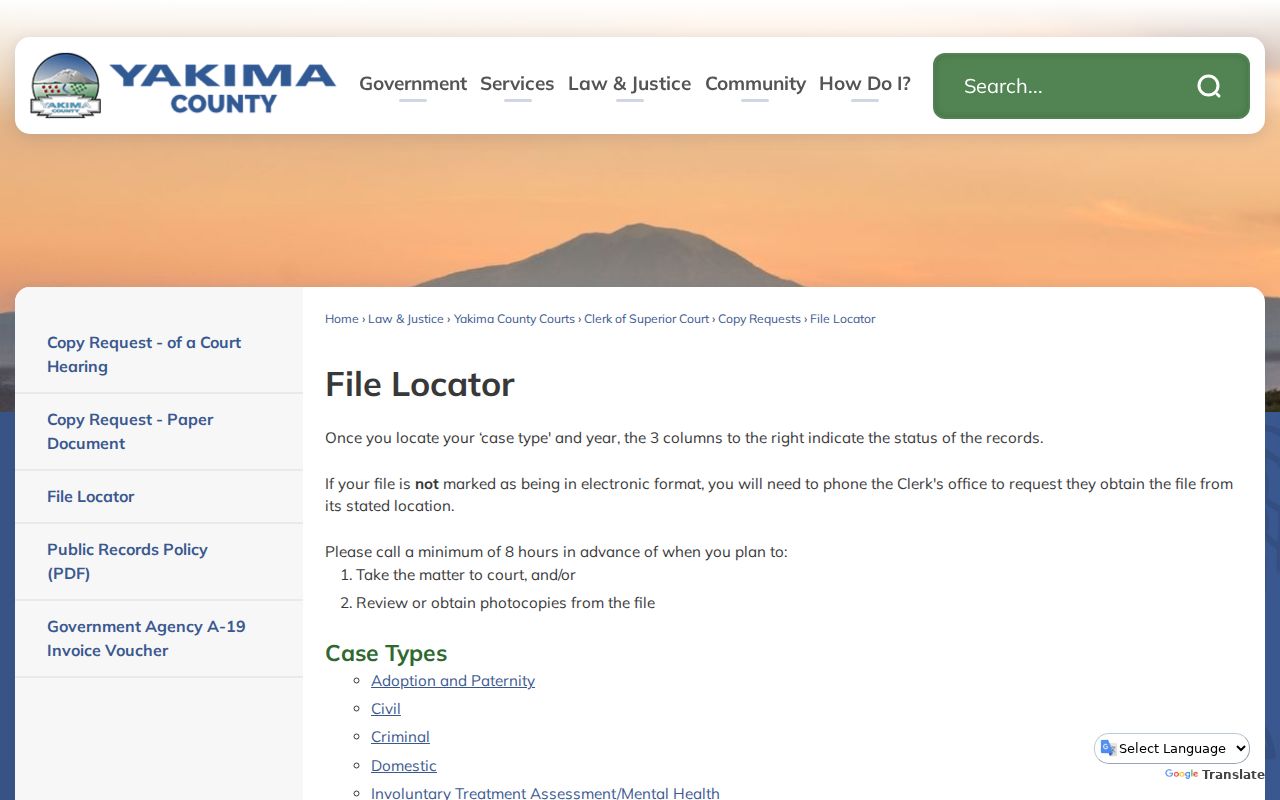
No online search can resolve every historical county docket.
Which Court Holds Criminal Dockets
Felonies live in Yakima County Superior Court. Yakima County District Court handles misdemeanors and gross misdemeanors within its limited jurisdiction, along with criminal traffic matters. Its service area includes Union Gap, Grandview, Mabton, Tieton, and Moxee, though AOC labels may show branches or municipal names separately. Municipal courts take the city cases. That covers misdemeanor, traffic, code, and ordinance matters. Yakima Municipal Court is separate from the County Clerk, and the city courts in Sunnyside, Selah, Granger, Wapato, and Zillah each run their own channels. Toppenish service may route through Sunnyside's court. Preserve the exact court label, and note that federal cases use PACER and the Eastern District clerk, not AOC.
Yakima County Criminal Copy Choices
Ask for the record that answers your question. A docket lays out the events. A complaint states allegations, while a plea form plus a judgment or sentence document shows the outcome more directly. Hearing audio is separate from docket text, and a transcript is a different product altogether.
| Need | Best request | Custodian |
|---|---|---|
| Felony event history | Superior docket or named pleading | County Clerk |
| District misdemeanor file | Docket, complaint, or conviction document | District Court |
| City criminal matter | City docket, instrument, or audio | Municipal court |
| State criminal history | WSP WATCH result | State Patrol |
The District request form covers a lot. You can order the docket, the complaint or citation, conviction papers, certification, or FTR Gold audio. The county says most requests are ready within 48 hours. After the ready notice arrives, payment is due within 96 hours. Weekends and holidays are excluded.
Yakima County Disposition Language
Never boil a search hit down to "criminal record." An accusation can end many ways: dismissal, plea, trial, conviction, or some other result. The outcome may shift later through appeal, sealing, or vacatur. RCW 9.96.060 lays out a process for vacating eligible misdemeanor and gross-misdemeanor convictions in the sentencing court, and a later vacatur changes how the result should be described. Go by the newest official event and its date. If the AOC status clashes with a filed judgment, take it up with the clerk. AOC itself warns that its data is not the complete court record and that status or outcome information may be inaccurate. The official court file wins.
Yakima County Criminal Workload
Numbers on workload need care. Washington Courts' 2025 Superior report counts 1,772 criminal filings in Yakima County. A separate resolutions table shows 3,604 total criminal resolutions: 2,773 in the felony category and 831 misdemeanor or gross-misdemeanor resolutions. Filings and resolutions track different work, and neither count stands for unique people or convictions.
The official Superior Court caseload report supplies the filing figure.
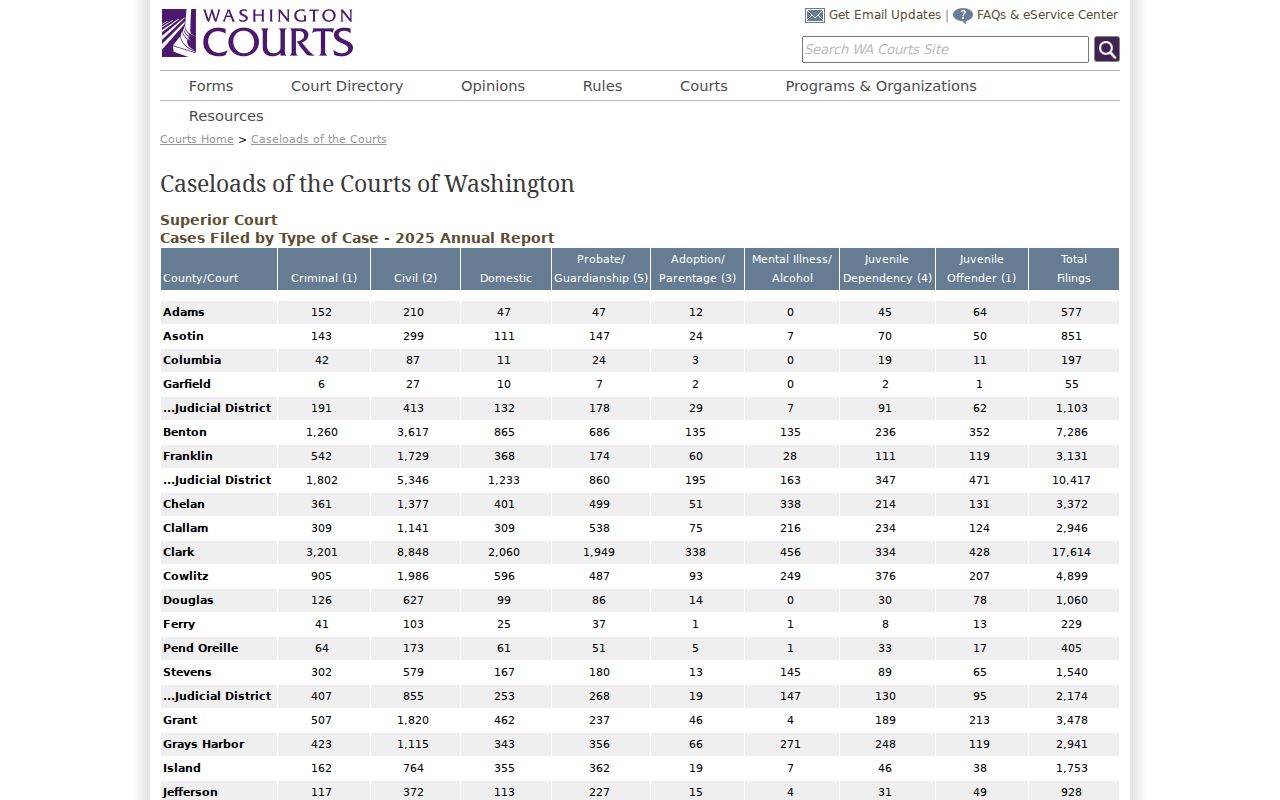
The table gives county context without revealing or drawing conclusions about any person.
Yakima County Missing Case Checks
A blank result has many possible causes. The court could be wrong, the spelling off, the case number in an old format, the data lagging, or the record restricted. First confirm the court and the year. Then search by case number. If nothing turns up, contact the named clerk and ask whether the file is electronic, paper, archived, destroyed under retention, sealed, confidential, or open only to an authorized requester. An empty public result does not mean nothing happened. AOC works as a locator, and Odyssey document access varies by court. Juvenile, sealed, and other protected matters may never show up for an anonymous user.
Yakima County Docket Privacy
Access starts with Washington General Rule 31. It presumes public access, subject to statute, court rule, order, and case law. The rule also curbs sensitive identifiers and bulk use. Social Security and financial-account numbers shrink to their last four digits, and driver's-license numbers are excluded or redacted. Viewing something publicly does not give you a right to republish protected data. A court docket is not a WSP criminal-history report. A calendar entry is not proof of a conviction either. Any account of a case should carry the filing court, source date, access limit, and exact disposition.
Public Access and Sealed Criminal Dockets
Walking into the courthouse to view public court records is free under GR 31. Copies, certification, audio, archived-file work, and staff searches may cost money. Restricted access can flow from a sealing order, juvenile law, victim protections, personal identifiers, or confidential subject matter. GR 31.1 governs court administrative records, not a criminal pleading.
Access rule: A missing docket or document is not proof of absence. Confirm venue and case number, then ask the filing court to classify the record.
Washington General Rule 31 governs access to court records.
RCW Chapter 13.50 supplies special rules for juvenile records.